
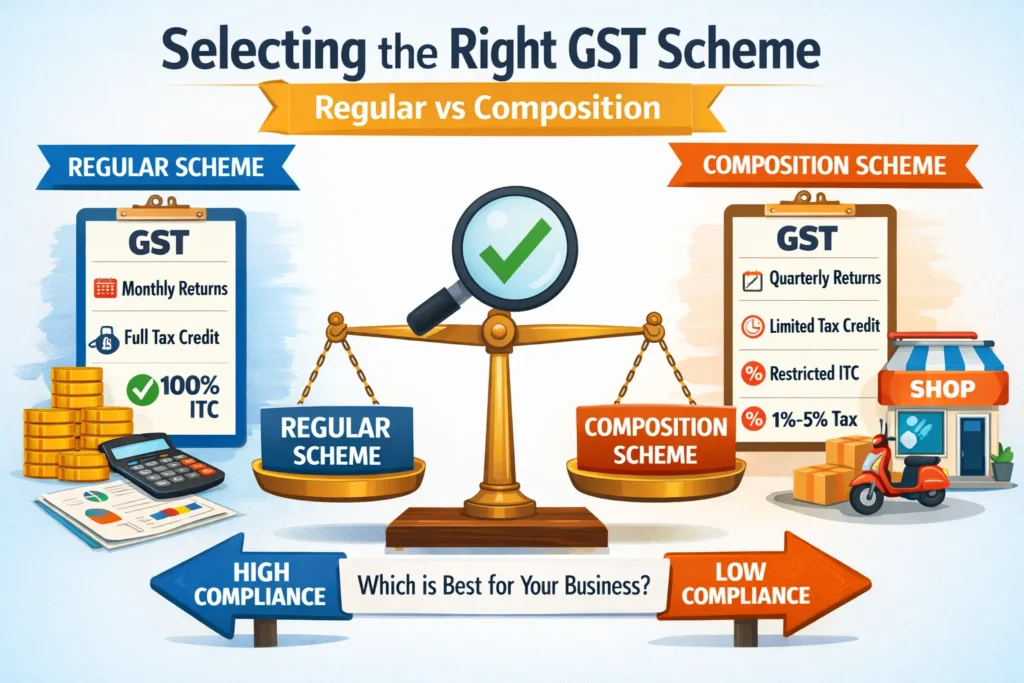
Under the Goods and Services Tax (GST) framework, businesses in India can choose between two primary schemes: the Regular GST Scheme and the Composition GST Scheme. Selecting the right scheme is essential, as it directly impacts tax liability, compliance requirements, pricing strategy, and business growth.
The Regular GST Scheme is suitable for businesses with higher turnover, inter-state operations, or those requiring Input Tax Credit (ITC). It allows full tax compliance with GST laws, enables ITC claims, and supports expansion across states and online platforms, though it involves higher compliance and return filing.
GST registration is required because it legally recognizes a business under the Goods and Services Tax (GST) system and allows smooth tax compliance.
The Composition GST Scheme, on the other hand, is designed for small businesses seeking simplified compliance. It offers lower, fixed tax rates and reduced filing requirements but restricts ITC claims and inter-state supplies. This scheme is best suited for businesses operating locally and catering primarily to end consumers.
How to Choose the Right GST Scheme?
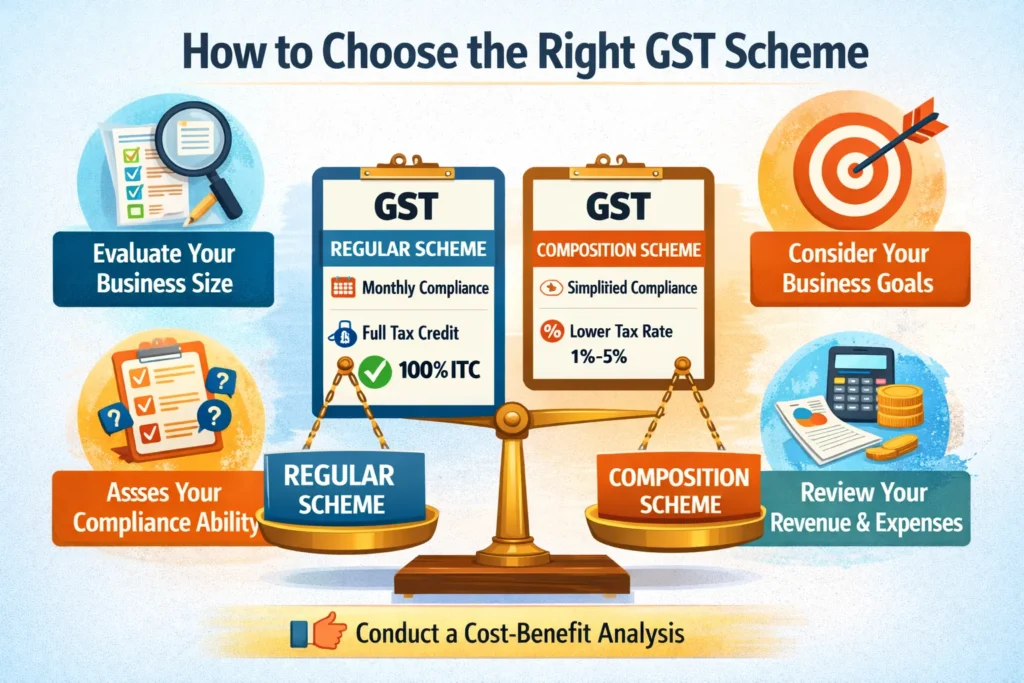
Choosing the right GST scheme is crucial for tax savings, compliance ease, and business growth. Under GST, businesses mainly choose between the Regular Scheme and the Composition Scheme. The right choice depends on your turnover, nature of business, and customer base.
Step 1: Check Your Annual Turnover
- Regular Scheme: No upper turnover limit
- Composition Scheme:
- Up to ₹1.5 crore for traders & manufacturers
- Up to ₹75 lakh for service providers (₹50 lakh in some states)
# If your turnover exceeds these limits, the Regular Scheme is mandatory.
Step 2: Understand Your Business Nature
Choose the Regular Scheme if you:
- Make inter-state supplies
- Sell through e-commerce platforms
- Export goods or services
- Deal with taxable supplies at varying GST rates
Choose the Composition Scheme if you:
- Operate within one state
- Sell mostly to end consumers
- Have limited purchases and simple operations
Step 3: Evaluate Input Tax Credit (ITC) Needs
- Regular Scheme: ITC allowed
- Composition Scheme: ITC not allowed
# If your business incurs significant GST on purchases, the Regular Scheme is more beneficial.
Step 4: Compare Compliance & Filing Requirements
| Particulars | Regular Scheme | Composition Scheme |
|---|---|---|
| GST Returns | Monthly / Quarterly | Quarterly |
| ITC | Available | Not Available |
| Tax Rate | As per GST slabs | Fixed lower rate |
| Compliance | Higher | Simplified |
Step 5: Consider Customer Profile
- If your customers are GST-registered businesses, they prefer suppliers under the Regular Scheme to claim ITC.
- If your customers are end consumers, the Composition Scheme may be more cost-effective.
GST Forms and Returns for Regular & Composition Schemes
GST compliance requirements vary depending on whether a business opts for the Regular GST Scheme or the Composition GST Scheme. Below is a simplified overview.
Regular GST Scheme
Key GST Forms
- GST REG-01 – Application for GST registration
- GST REG-06 – GST Registration Certificate
- GST REG-14 – Amendment in registration details
- GST REG-16 – Application for cancellation of GST
GST Returns to Be Filed
- GSTR-1 – Details of outward supplies
(Monthly or Quarterly under QRMP) - GSTR-3B – Summary return with tax payment
(Monthly) - GSTR-9 – Annual return
- GSTR-9C – Reconciliation statement (if applicable)
Composition GST Scheme
Key GST Forms
- GST CMP-02 – Intimation to opt for Composition Scheme
- GST CMP-08 – Statement for tax payment
- GST REG-01 – Registration (if new taxpayer)
- GST REG-14 – Amendment in registration details
GST Returns to Be Filed
- GSTR-4 – Annual return for composition taxpayers
- CMP-08 – Quarterly tax payment statement
Quick Comparison Table
| Particulars | Regular Scheme | Composition Scheme |
|---|---|---|
| Registration Form | REG-01 | REG-01 / CMP-02 |
| Outward Supply Return | GSTR-1 | Not required |
| Monthly Summary | GSTR-3B | Not required |
| Quarterly Payment | Optional (QRMP) | CMP-08 |
| Annual Return | GSTR-9 | GSTR-4 |
| Audit Return | GSTR-9C (if applicable) | Not applicable |
# The regular scheme involves detailed and frequent compliance but allows ITC and business expansion.
## The composition scheme offers simplified returns and lower compliance, ideal for small, local businesses.
How to Get GST Registration in India
GST registration can be completed fully online, making the process convenient and quick. Follow these steps:
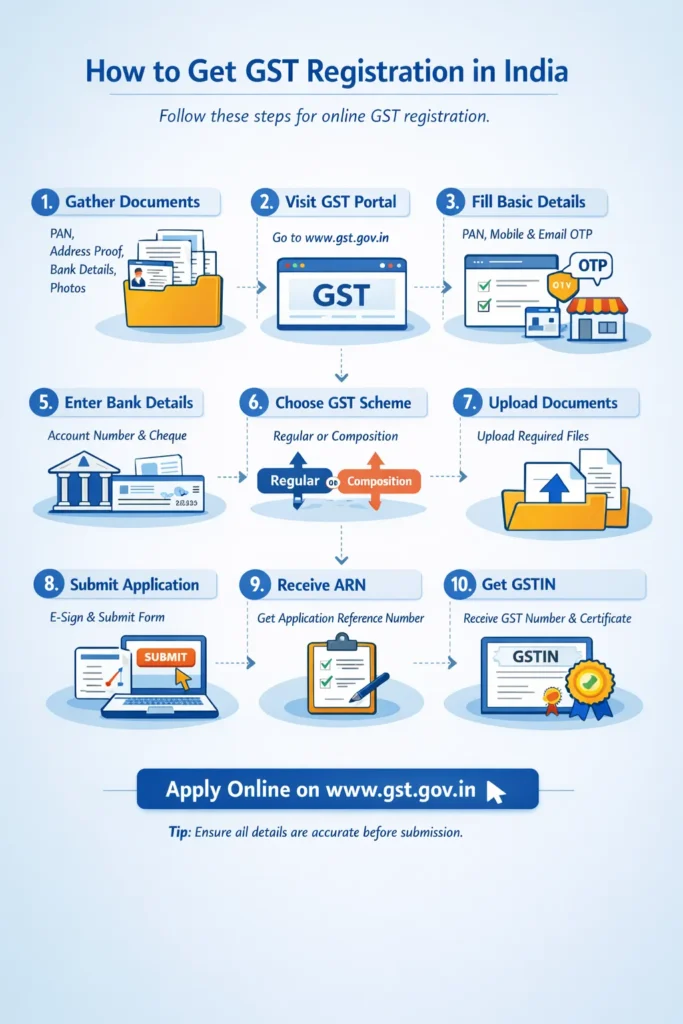
Step 1: Gather Required Documents
Before starting, ensure you have the documents according to your business entity type:
- PAN card of the business/entity
- Aadhaar card (for individuals/partners)
- Proof of business address (rent agreement, electricity bill, property tax receipt)
- Bank account details (cancelled cheque or statement)
- Photographs of proprietor/partners/directors
- Authorization letter/board resolution for authorized signatory (if applicable)
Step 2: Visit GST Portal
- Go to the official GST portal: www.gst.gov.in
- Click on “Register Now” → New Registration
Step 3: Fill Basic Details
- Select Taxpayer Type (Regular, Composition, Non-Resident, etc.)
- Enter PAN, mobile number, and email address
- An OTP will be sent to your mobile and email for verification
Step 4: Submit Business & Owner Details
- Provide details about your business: name, constitution, constitution of ownership
- Upload address proof and photographs
- Mention principal place of business and additional places (if any)
Step 5: Enter Bank Account Details
- Fill in your bank account number and IFSC code
- Upload a cancelled cheque or bank statement for verification
Step 6: Select GST Scheme
- Choose Regular Scheme or Composition Scheme
- Ensure your choice matches turnover and business operations
Step 7: Upload Documents
Upload scanned copies of all required documents as per your business entity.
Step 8: Verification and Submission
- Verify all details carefully
- Submit the application using Digital Signature Certificate (DSC) for companies/LLPs or Aadhaar-based e-sign for individuals/partnerships
Step 9: Receive ARN
- After submission, you will receive an Application Reference Number (ARN)
- Use the ARN to track the status of your application
Step 10: Approval and GSTIN
- The GST officer may ask for clarification or additional documents (if required)
- Once approved, you will receive a GSTIN (GST Identification Number) and GST registration certificate via email
Frequently Asked Questions (FAQs): Choosing the Right GST Scheme
1. What are the main GST schemes available for taxpayers?
There are two primary GST schemes:
- Regular Scheme—Suitable for businesses that want to claim Input Tax Credit (ITC) and deal with inter-state supplies.
- Composition Scheme—Designed for small businesses seeking simplified compliance and lower tax rates.
2. Who should opt for the Regular GST Scheme?
Businesses should choose the Regular Scheme if they:
- Want to claim Input Tax Credit (ITC)
- Supply goods or services inter-state
- Deal with B2B customers
- Have turnover exceeding the Composition Scheme limits
3. Who is eligible for the Composition Scheme?
The Composition Scheme is suitable for:
- Small businesses with turnover up to the prescribed limit under GST law
- Businesses mainly involved in local (intra-state) supplies
- Taxpayers looking for lower tax rates and simpler compliance
4. Can a composition dealer claim Input Tax Credit (ITC)?
No. Input Tax Credit is not allowed under the Composition Scheme. Taxes paid on purchases become a cost to the business.
5. How do return filing requirements differ between the two schemes?
- Regular Scheme: Monthly returns (GSTR-1, GSTR-3B) and annual return
- Composition Scheme: Quarterly return (CMP-08) and annual return (GSTR-4)
6. Is inter-state supply allowed under the Composition Scheme?
No. A taxpayer registered under the Composition Scheme cannot make inter-state supplies.
7. Can I switch between the regular and composition scheme?
Yes. Eligible taxpayers can switch schemes:
- At the beginning of a financial year
- By filing the prescribed intimation form on the GST portal
8. How does turnover affect the choice of GST scheme?
Turnover plays a crucial role:
- Businesses below the threshold may opt for the Composition Scheme
- Growing businesses or those crossing the limit must move to the Regular Scheme
9. Which scheme is better for long-term business growth?
The Regular GST Scheme is generally better for long-term growth, as it
- Allows ITC
- Supports inter-state trade
- Is more suitable for scaling businesses
10. How can I decide which GST scheme is best for my business?
You should evaluate:
- Nature of business (goods/services)
- Turnover and growth plans
- Compliance capacity
- Need for Input Tax Credit
A cost–benefit analysis or professional advice can help in making the right choice.

Leave a Reply