GSTR-9 is an annual return that regular taxpayers registered under GST must file once for every financial year. It is a consolidated summary of all monthly/quarterly returns filed during the year.
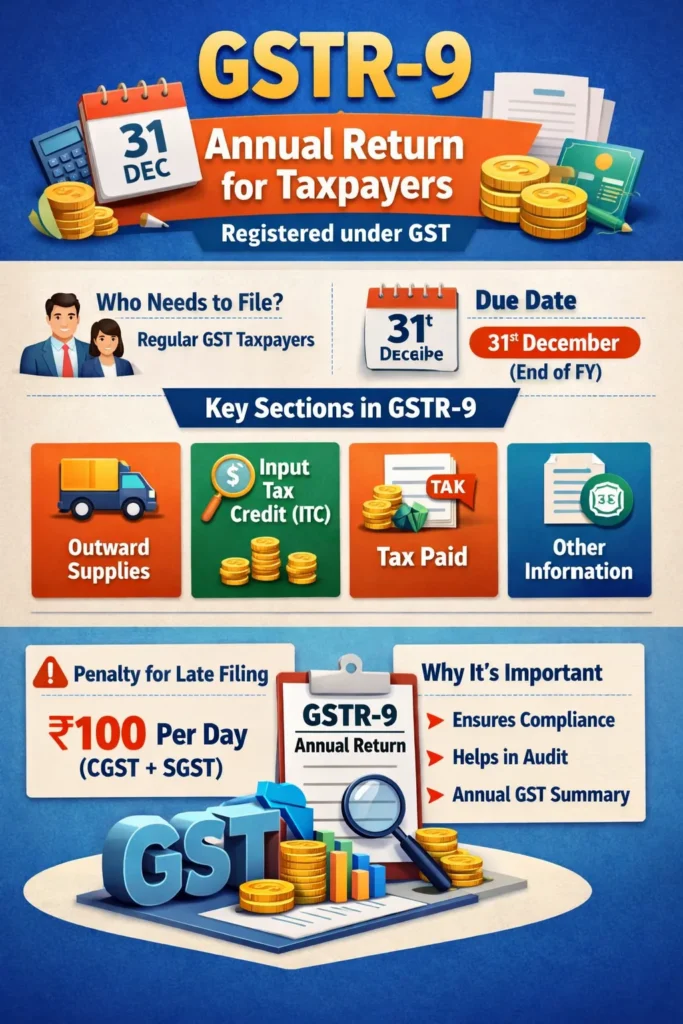
What is GSTR-9?
GSTR-9 is the Annual GST Return that regular taxpayers registered under GST must file once every financial year.
It is a summary return that consolidates all the details already filed in:
- GSTR-1 (Outward supplies)
- GSTR-3B (Monthly/Quarterly summary return)
In Simple Words:
GSTR-9 is like a yearly report card of your GST transactions.
It summarizes:
- Total sales (taxable, exempt, nil-rated)
- Total purchases
- Input Tax Credit (ITC) claimed
- GST paid during the year
- Refunds and demands, if any
Who Files GSTR-9?
- Regular GST taxpayers
- Businesses with turnover above ₹2 crore (mandatory)
- Turnover up to ₹2 crore—filing is optional (as per latest relaxations)
Due Date
31st December following the end of the financial year
(Example: For FY 2025–26 → Due date is 31st December 2026)
Who is Required to File GSTR-9?
The following taxpayers must file GSTR-9:
- Regular taxpayers registered under GST
- Businesses filing GSTR-1 and GSTR-3B
Who is NOT Required to File?
- Composition taxpayers (they file GSTR-9A)
- Casual taxable persons
- Non-resident taxable persons
- Input Service Distributors (ISD)
- Persons required to deduct/collect TDS or TCS
Types of GSTR-9 (Annual GST Returns)
Under GST, there are different types of GSTR-9 forms based on the category of taxpayer:
GSTR-9
For Regular Taxpayers
- Filed by taxpayers who file GSTR-1 & GSTR-3B
- It is a consolidated annual summary of outward supplies, ITC, and tax paid.
- Mandatory if turnover exceeds the prescribed limit (as notified).
GSTR-9A
For Composition Scheme Taxpayers
- Filed by taxpayers registered under Composition Scheme (Section 10)
- It summarizes quarterly CMP-08 and other details.
- (Note: Filing requirement has been relaxed for certain years.)
GSTR-9B
For E-Commerce Operators (TCS Collectors)
- Filed by e-commerce operators who collect TCS under Section 52.
- Annual statement of supplies made through the platform.
GSTR-9C
Reconciliation Statement
- Filed by taxpayers whose turnover exceeds the prescribed limit.
- It is a reconciliation statement between:
- Audited Financial Statements
- GSTR-9 Annual Return
- Certified by a CA/CMA (self-certified as per latest amendments).
Quick Summary Table
| Form | Applicable To | Purpose |
|---|---|---|
| GSTR-9 | Regular taxpayers | Annual summary return |
| GSTR-9A | Composition dealers | Annual return |
| GSTR-9C | High-turnover taxpayers | Reconciliation statement |
| GSTR-9B | E-commerce operators | Annual TCS statement |
Step-by-Step Filing Process of GSTR-9 (Annual Return)
Filing GSTR-9 (Annual Return) is an important compliance requirement for regular GST taxpayers. It is a consolidated summary of all monthly/quarterly returns (GSTR-1 & GSTR-3B) filed during the financial year. Before filing, proper reconciliation of turnover, Input Tax Credit (ITC), and tax paid with books of accounts is essential because GSTR-9 cannot be revised once submitted. Below is the complete step-by-step filing process in simple and practical language.
Step 1: Login to GST Portal
- Visit www.gst.gov.in
- Click on Login
- Enter Username, Password & Captcha
Step 2: Navigate to Annual Return
- Go to Services
- Click Returns
- Select Annual Return
- Choose the Financial Year
- Click on GSTR-9
Step 3: Download System-Generated Data
- Download:
- GSTR-1 summary
- GSTR-3B summary
- Keep books of accounts ready
- Reconcile turnover, ITC, and tax paid
Reconciliation is very important before filing.
Step 4: Fill the Required Details
GSTR-9 contains 6 parts:
- Basic Details—Auto-populated
- Outward Supplies—Taxable, exempt, nil-rated
- ITC Details – Availed, reversed, ineligible
- Tax Paid – CGST, SGST, IGST, Cess
- Previous FY Transactions—Reported in current year
- Other Information—Refunds, demands, HSN summary
Fill in missing details carefully.
Step 5: Compute Liabilities (If Any)
- Click on Compute Liabilities
- Pay additional tax (if required) through DRC-03
Step 6: Preview Draft GSTR-9
- Click Preview Draft GSTR-9 (PDF)
- Verify all details properly
# Check turnover
# Check ITC
# Check tax paid
Step 7: File GSTR-9
- Select the declaration checkbox
- Choose:
- DSC (Digital Signature)—For companies/LLPs
- EVC (OTP-based) – For others
- Click File GSTR-9
Step 8: Download Filed Return
- After successful filing, download:
- Filed GSTR-9
- ARN (Acknowledgment Reference Number)
Keep it for records.
Penalty for Non-Compliance – GSTR-9 (Annual Return under GST)
Non-filing or late filing of GSTR-9 can attract late fees and other legal consequences under GST law.
1. Late Filing Fees (Section 47)
If GSTR-9 is not filed within the due date:
- ₹100 per day under CGST
- ₹100 per day under SGST
- Total = ₹200 per day
Maximum Late Fee:
0.25% of turnover in the State/UT (0.25% CGST + 0.25% SGST, subject to notifications and turnover-based caps).
Note: The Government may provide reduced late fees for small taxpayers through notifications.
2. Notice from Department
If not filed:
- GST department may issue a Notice (Section 46).
- Continued failure can lead to best judgment assessment (Section 62).
3. Interest on Additional Tax Liability
If during reconciliation any tax is payable:
- Interest @ 18% per annum applies on delayed payment.
- Must be paid through Form DRC-03.
4. Blocking of E-Way Bill / GSTIN Issues
Persistent non-compliance may lead to:
- Blocking of e-way bill generation
- Suspension or cancellation of GST registration
5. Impact on Compliance Rating
Non-filing affects:
- GST compliance record
- Future scrutiny or audit risk
Important Points
- GSTR-9 cannot be revised once filed
- A late fee applies if filed after due date
- Ensure proper reconciliation before filing
FAQs – Annual Return for Taxpayers Registered under GST (GSTR-9)
1. What is GSTR-9?
GSTR-9 is an annual return that consolidates all monthly/quarterly GST returns (GSTR-1 & GSTR-3B) filed during a financial year.
2. Who is required to file GSTR-9?
All regular GST-registered taxpayers are required to file GSTR-9, subject to turnover limits and government notifications.
3. Who is not required to file GSTR-9?
The following are not required:
- Composition taxpayers (they file GSTR-9A, if applicable)
- Casual taxable persons
- Non-resident taxable persons
- Input Service Distributors (ISD)
- TDS/TCS deductors
4. What is the due date for filing GSTR-9?
The due date is generally 31st December following the end of the relevant financial year (unless extended by the government).
5. Is GSTR-9 mandatory for small taxpayers?
For taxpayers with turnover up to the prescribed limit (as notified), filing may be optional. However, it is mandatory for those exceeding the notified turnover threshold.
6. Can GSTR-9 be revised after filing?
No. Once filed, GSTR-9 cannot be revised. Therefore, proper reconciliation is very important before submission.
7. What happens if GSTR-9 is filed late?
Late fees are applicable:
- ₹100 per day under CGST
- ₹100 per day under SGST
Subject to a maximum limit prescribed under GST law.
8. What details are included in GSTR-9?
It includes:
- Outward supplies
- Inward supplies & ITC
- Tax paid
- Refund details
- HSN summary
- Demands and late fees
9. Is additional tax payable while filing GSTR-9?
Yes, if any tax liability is identified during reconciliation, it must be paid through Form DRC-03 before filing.
10. What is the difference between GSTR-9 and GSTR-9C?
GSTR-9C → Reconciliation statement (applicable to taxpayers above the prescribed turnover limit)
GSTR-9 → Annual return summary

Leave a Reply